Biogenetics
- Home
- Our Service
- Biogenetics
GENETIC TESTS

WES
Whole Exome Sequencing (WES) is a comprehensive analysis method used in the diagnosis of genetic diseases.
It helps identify diseases caused by genetic variations by examining all exonic regions.
LIQUID BIOPSY
This non-invasive test, performed using a blood sample, enables early diagnosis of cancer by detecting tumour DNA.
It is an effective method for monitoring treatment and tracking the course of the disease.
HEREDITARY GENE SCREENING
It is used to identify genetic diseases passed down through families.
It helps identify carrier status and hereditary risk factors at an early stage.
BROAD PANEL GENE MUTATION SCREENING
This method, which analyses multiple genes simultaneously, has been developed to investigate the causes of complex diseases.
It contributes to the creation of personalised diagnosis and treatment plans.
CANCER VACCINES
DENDITIC CELL VACCINE
It is prepared by specifically training the patient’s own immune cells against tumour cells in a laboratory environment.
It aims to target cancer cells by activating the immune system.
CAR-T CELL VACCINE
The patient’s T cells are genetically modified to recognise and destroy cancer cells.
It is an effective treatment method, particularly for haematological cancers such as leukaemia and lymphoma.
TUMOUR VACCINE
Antigens obtained from tumour cells encourage the immune system to recognise and attack cancer cells.
It creates a body-specific immune response.
NK-CELL VACCINE
The defence against cancer cells is increased by enhancing natural killer cells.
It aims to control tumour spread by supporting the immune system.

STEM CELL THERAPIES

AUTOTOLOGICAL STEM CELL TRANSPLANTATION
This treatment method, which uses the patient’s own stem cells, is preferred especially in cancer and some hematological diseases. It provides rapid healing by increasing the body’s capacity to produce blood again.
ALLOGENIC STEM CELL TRANSPLANTATION
It is based on the principle of transplanting stem cells taken from a suitable donor to the patient. This method offers an effective solution in the treatment of immune system diseases and genetic disorders.
CORD BLOOD TRANSPLANTATION
Stem cells in cord blood taken during birth are used as a treatment option, especially in childhood diseases. It provides a significant advantage thanks to the flexibility of immune response.
MESENCHYMAL STEM CELL TREATMENTS
These cells, used in the repair of muscle, cartilage, bone, and connective tissues, support tissue regeneration. With its anti-inflammatory effect, it holds an important place in regenerative medicine.
INDUCED PLURIPOTENT STEM CELL (IPSC) TREATMENTS
These stem cells, obtained by reprogramming adult cells, offer personalized treatment options. They are revolutionary in the research and treatment of genetic diseases.
EMBRYONIC STEM CELL TREATMENTS
These cells, obtained from embryos, have the ability to transform into all body cell types. They are used in advanced treatment areas such as nervous system and organ repair.
NEUROSURGERY
BRAIN TUMOR SURGERIES
These operations, which involve the surgical removal of tumors developing in the brain, aim to preserve neurological functions.
High success rates are achieved thanks to advanced imaging and microsurgical techniques.
CHILDHOOD BRAIN TUMOR SURGERIES
Special surgical approaches are applied in the treatment of brain tumors seen in children.
Considering growth and development processes, the aim is both to remove the tumor and to preserve the quality of life.
PARKINSON’S PACEMAKER APPLICATIONS
In Parkinson’s disease, tremors and muscle stiffness are controlled thanks to electrodes placed in specific areas of the brain.
This method, known as deep brain stimulation, significantly improves the quality of life.
EPILEPSY SURGERIES
In epilepsy patients who do not respond to drug treatment, the goal is to surgically remove the brain regions that cause seizures.
These operations reduce the frequency of seizures and improve quality of life.
SPINAL CORD TUMOR SURGERIES
Spinal cord functions are preserved by surgically removing benign or malignant tumors that develop in the spinal cord.
Thanks to modern surgical techniques, the risk of paralysis is minimized and the patient’s mobility is restored.

INTERVENTIONAL RADIOLOGY

AORTIC ANEURYSM SURGERIES
Surgical repair of aneurysms caused by the widening of the aorta aims to prevent the risk of life-threatening rupture. The most appropriate treatment plan is created according to the patient’s general condition using endovascular and open surgical methods.
BRAIN CAVERNOMA
Cavernomas, which are formed by the abnormal widening of brain vessels, can lead to bleeding or epileptic seizures. The goal is to safely remove these lesions using microsurgical techniques.
BRAIN ARTERIOVENOUS MALFORMATION
This vascular disorder, consisting of abnormal connections between arteries and veins, increases the risk of brain hemorrhage. A personalized treatment plan is applied using methods such as surgery, embolization, or radiosurgery.
ANGIOGRAPHY TREATMENTS
These are minimally invasive treatment methods applied in cases such as vascular blockages, aneurysms, or malformations. Thanks to imaging-guided interventions, patients can return to their normal lives in a short time.
TACE
Transarterial Chemoembolization (TACE) is a targeted method used in the treatment of liver tumors. By injecting drugs and embolic substances into the vessels that nourish the tumor, blood flow is cut off and the tumor is shrunk.
TARE
Transarterial Radioembolization (TARE) is based on the principle of directly sending radioactive microspheres to liver tumors. It both shrinks the tumor and causes minimal damage to healthy tissues.
NEURAL BLOCK PAIN TREATMENT
This treatment method, in which pain transmission is stopped by temporarily blocking nerve pathways, is effective in controlling chronic pain. It provides a comfortable life for patients, especially those with back, neck, and migraine pain.
CARDIOVASCULAR SURGERY
CLOSED BYPASS SURGERY
Closed bypass surgeries performed using minimally invasive techniques are used to treat coronary artery blockages. As they are performed through small incisions, recovery time is short and the risk of infection is low.
CORONARY ANGIOGRAPHY
This is a diagnostic method used to visualise the condition of the heart vessels. The degree of vessel blockage is determined, and angioplasty or stent treatment is performed when necessary.
CARDIOMYOPATHY
This disease, which arises from structural or functional disorders of the heart muscle, can lead to heart failure. With early diagnosis and appropriate treatment, heart function can be controlled.
HEART VALVE DISEASES
If problems such as narrowing or leakage are observed in the heart valves, valve repair or replacement can be performed using surgical or closed methods. These treatments restore the heart’s blood pumping capacity.
PULMONARY HYPERTENSION
This disease, which develops due to high pressure in the pulmonary arteries, strains the right side of the heart. It can be controlled with medication, lifestyle changes, and, in advanced cases, surgical interventions.

HEAD AND NECK SURGERY

- Cochlear Implant
- Cholesteatoma Surgery
- Partial Laryngectomy
- Total Laryngectomy
- Pharyngolaryngectomy
- Partial or Total Glossectomy (Tongue Resection)
- Mandibulectomy (Jawbone Resection)
- Maxillectomy (Upper Jaw Resection)
- Composite Resection (Removal of Multiple Organs/Tissues)
- Neck Dissection
- Reconstruction with Free Flaps (Microvascular Techniques)
- Endoscopic Endonasal Tumor Resections


Plan your health journey with a doctor’s mind.
Intermediary Healthcare Services
Contact
- Aşık Veysel Mah. Resneli Niyazi Sk. Greens Outland No:4 İç Kapı No: 131 Esenyurt / İstanbul
- info@hmosaglik.com
- +90 850 999 58 87
- +90 530 131 30 75
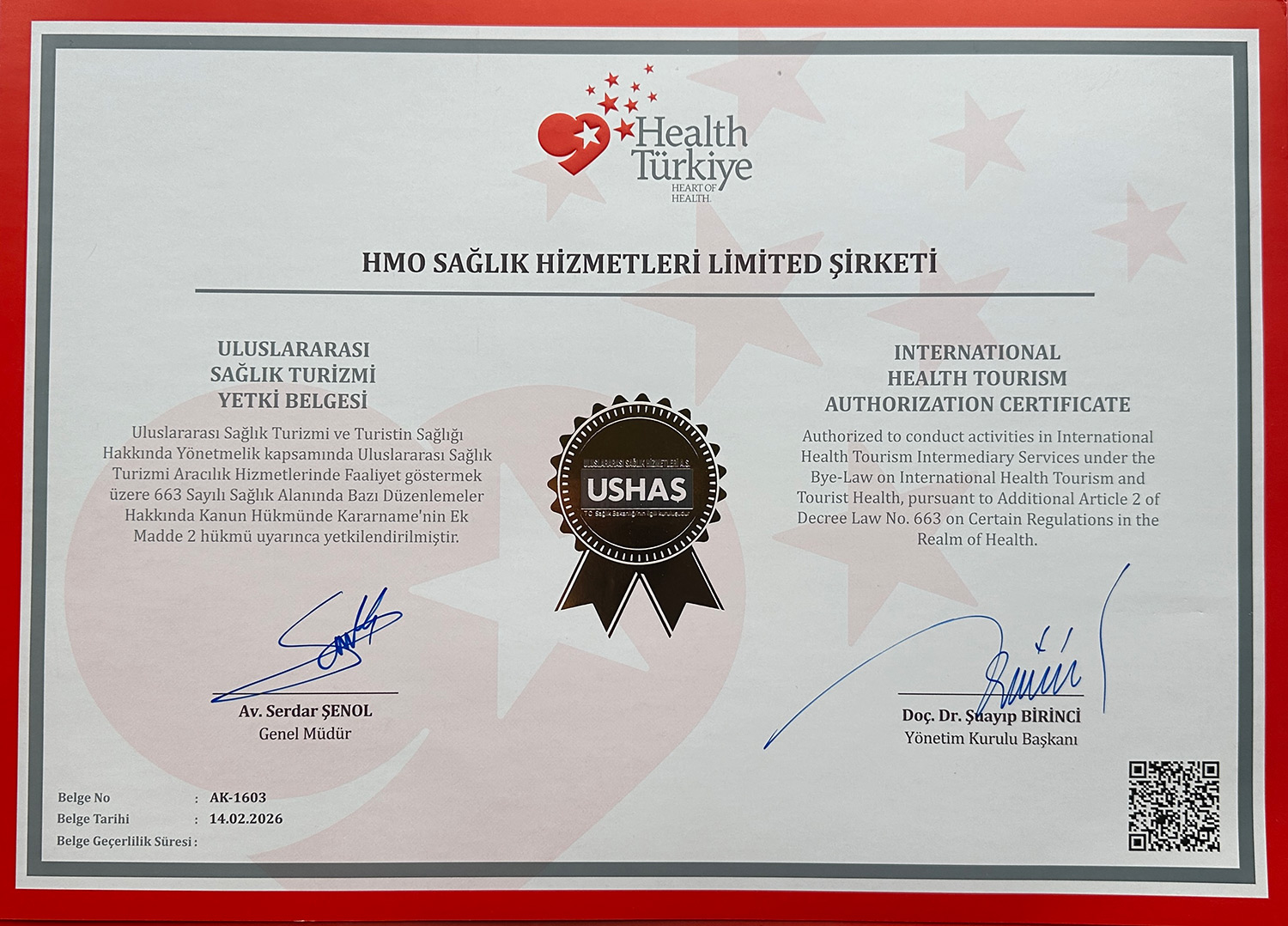
Certificate